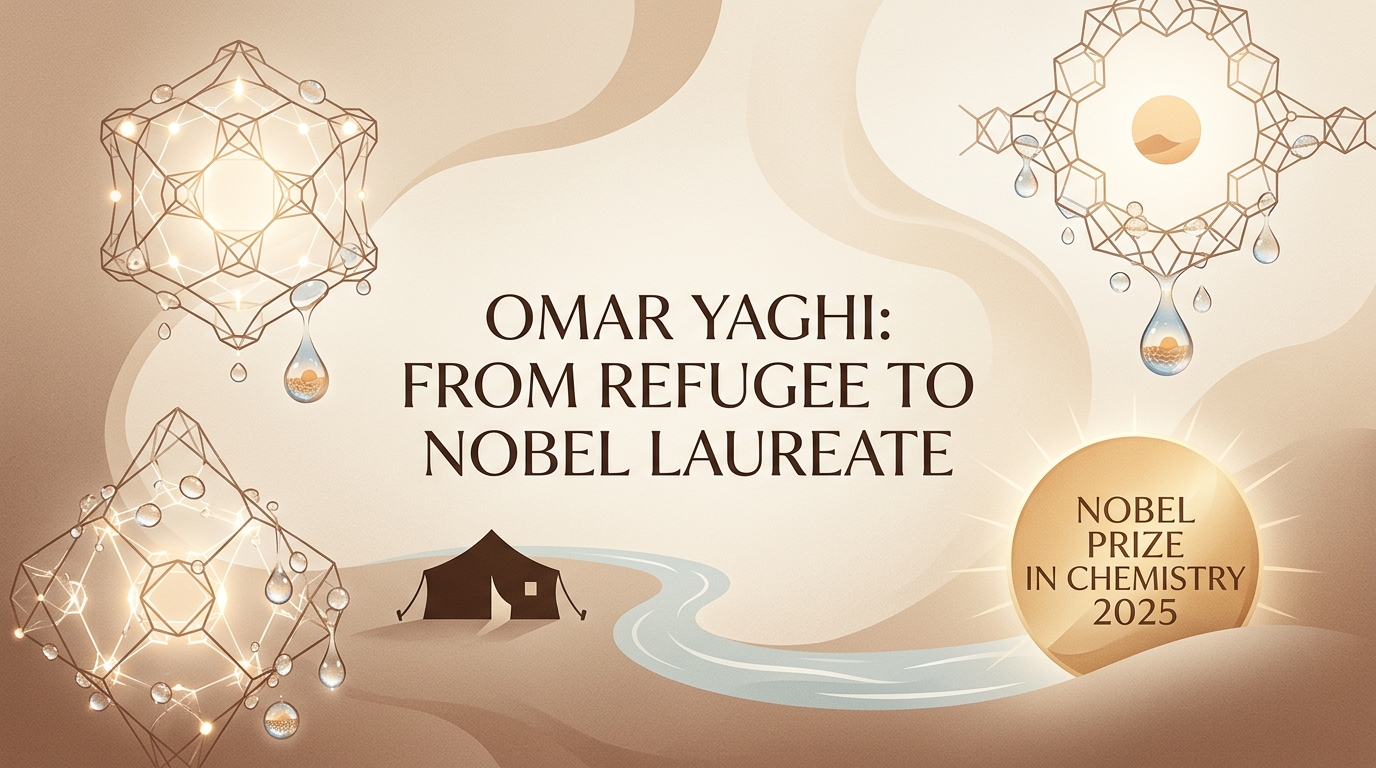
Omar Yaghi, Palestinian, Grew Up as Refugee, Nobel Prize Winner
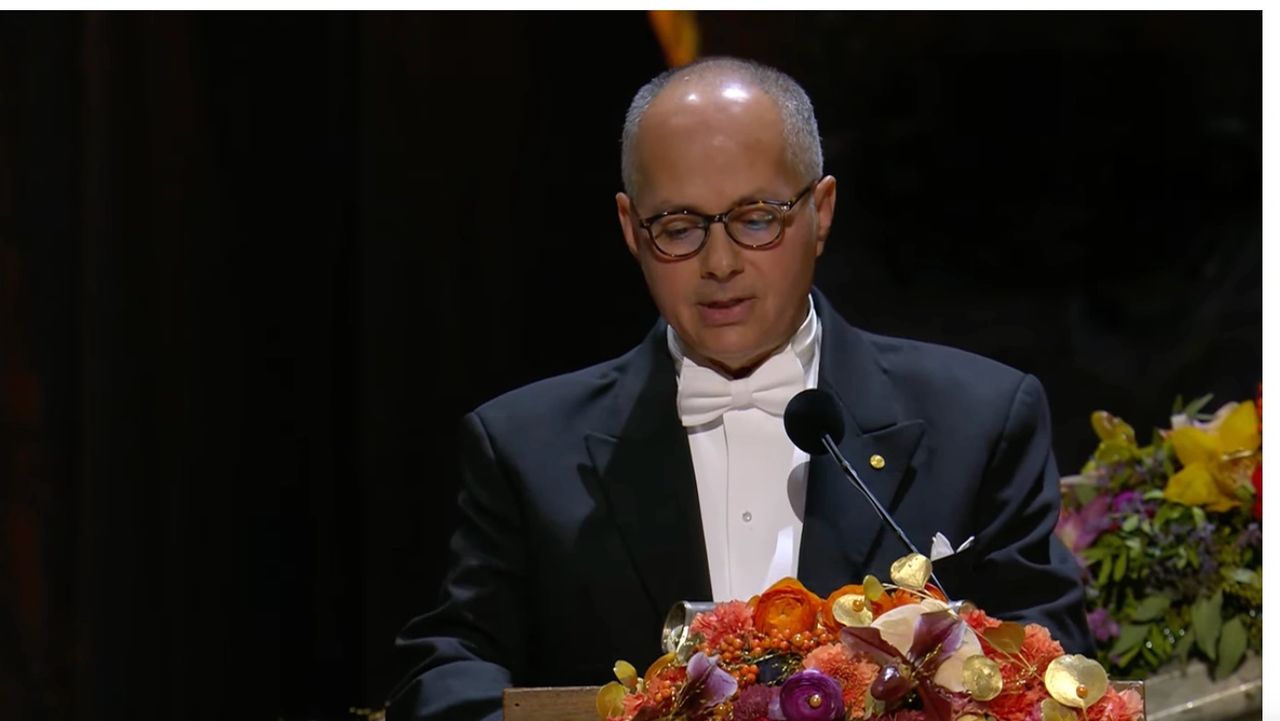
Omar Yaghi Palestinian, Grew Up in Amman, Jordan as Refugee, Nobel Prize Winner, Speech at the banquet December 10, 2025
Your Majesties,
Your Royal Highnesses,
Excellences,
Dear laureates,
Ladies and gentlemen—
On behalf of my co-laureates Susumu Kitagawa, Richard Robson, and myself, I thank the Royal Swedish Academy of Sciences and the Nobel Foundation for this extraordinary honor.
Tonight, we celebrate not only achievement but possibility—the power of human curiosity to reshape the world. Our development of metal–organic frameworks, or MOFs, began with a simple but bold idea: that we could design materials with atomic precision, forming strong purposeful bonds that unlock remarkable functions.
From this idea came new possibilities: the power of pulling pure water from desert air, capturing carbon dioxide directly from the sky. These are only early chapters. With countless structures and applications, MOFs are rapidly moving from promise to practical tools that are changing countless lives.
My journey began far from any laboratory. I grew up in Amman, Jordan, in a refugee family of ten children, in a home with no running water and no electricity, sharing our space with livestock, our family’s livelihood. Hardship was everywhere. My chances for success were slim—except for the surprising ways nature reveals itself and helps us overcome.
My turning point came at the age of ten, when I discovered drawings of molecules in my school library. Their beauty and mystery captivated me, and when I learned that they are the building blocks of everything, living and non-living, they ignited my passion for chemistry, and I was hooked forever. It became my escape and my direction.
Another childhood experience shaped me just as deeply. In the desert, water arrived from the government once every week or two. I remember the whisper through our neighborhood, “the water is coming,” and the urgency as I rushed to fill every container I can find before the flow stopped.
Many years later, while studying how MOFs take and release water, I recognized something revolutionary in what seemed like an ordinary behavior. I saw how this MOF could pull water from desert air and turn it into clean drinking water. It echoed the rhythm of my childhood—yet now offered a solution to the very hardship we had once endured. I often wonder whether I would have recognized that pattern of data had I not lived it first.
But MOF’s deeper lesson lies in their metaphor: a MOF’s strength comes from the bonds between its molecules—just as our future depends on the bonds we build across nations and generations. MOF science is now practiced in more than 100 countries, inspiring young people everywhere, especially in the developing world.
And here lies our greatest hope: a science capable of reimagining matter, and a generation eager to move it forward. I urge our leaders to act. Scientists are not asking for privilege, but for possibility. Support their curiosity. Remove barriers. Protect academic freedom. Welcome global talent.
And on climate, the hour for collective action has already arrived. The science is here. What we need now is courage—courage scaled to the enormity of the task—so we may gift the next generation not only carbon capture, but a planet worthy of their hopes.
I imagine a future where practicing chemistry does not require being a chemist, where discovery is accessible to all. Advances in AI may make this possible—a future where chemistry becomes not only a science of progress but a science of hope. A future where no child faces the limitations I once knew, but grows into a world more stable, more abundant, and more just.
Thank you.