Sustenance, Causes, Creator of Causes & Spiritual Trust
Sustenance (Rizq), Causes (Asbab), Creator of Causes (Musabbib–al–Asbab) & Spiritual Trust (Tawakkul)
Sustenance (Rizq) is linked to causes (Asbab), but only God, Almighty alone has created those causes. The majority of people are preoccupied with these causes, experiencing restlessness and anxiety. Very few are those whose vision encompasses the Creator of causes (Musabbib-al-Asbab).
A core paradox in Islamic spirituality: the balance between Asbab (physical means) and Tawakkul (spiritual trust).
* The Deception of Means (Asbab): Most people become “restless” because they believe their hard work, their job, or their connections are the source of their success. When these means fail, their peace vanishes.
* The Causer of Causes (Musabbib–ul–Asbab): This title of God, Almighty reminds us that while we use a “ladder” (a sabab) to reach a goal, it is God, Almighty who created the wood, the strength in your arms, and the goal itself. True peace (Itminan) comes from realizing that if God, Almighty wills, He can provide even without the means, just as He provides for the birds.
* Provision (Rizq): While often thought of as money, it includes everything God, Almighty bestows, such as health, knowledge, and peace.
* “Tie Your Camel”: The Prophet Muhammad (PBUH) famously taught, “Tie your camel and trust in Allah”. This means we must fulfill our worldly duties (using the Asbab) while keeping our hearts detached from the outcome, knowing the result belongs to the God, Almighty (Musabbib.)
* The Fruit of this Gaze: Those who look at the “Causer” instead of the “causes” are shielded from anxiety. They understand that if a door closes, it was by the decree of the One who owns all doors, God, Almighty, His Will is my will.
“Provision is bound to earthly means,
Yet the means themselves are but His creation.
The many wander restless, chasing the shadows of cause,
While the few find peace, their eyes fixed solely on the Creator of Causes.”
The Quran provides several profound verses that mirror this message reminding us that while humans may struggle with “means,” it is the Creator of those means who ultimately holds the provision.
1. The Ultimate Source of Provision
Even when we use earthly means, the Quran reminds us that no creature is left without divine support.
* Quran (11:6): “And there is no creature on earth but that upon God, Almighty is its provision…”
* Quran (51:58): “Indeed, God, Almighty is the [continual] Provider, the firm possessor of strength.”
2. Provision Beyond Earthly “Means”
The story of Maryam (A.S.) is a prime example of provision coming from the Musabbib-ul-Asbab without typical human causes.
* Quran (3:37): In this Ayat, the story of Maryam (A.S.) is a prime example of provision coming from, The Causer of Causes Musabbib–ul–Asbab without typical human causes. Sure When the Prophet Zechariah (A.S.) asked her where her food came from, she replied, “It is from God, Almighty, Indeed, God, Almighty provides for whom He wills without account.” This sight so moved him that he realized the “Causer of Causes” could grant him a son even in old age.
3. The Promise for Those Who Look Beyond the “Means”
For those who focus on God, Almighty-consciousness (Taqwa) and trust (Tawakkul) rather than just the physical struggle, Allah promises unexpected outcomes.
* Quran (65:2-3) “…And whoever fears God, Almighty—He will make for him a way out and will provide for him from where he does not expect. And whoever relies upon God, Almighty—then He is sufficient for him.”
4. Why the Majority Remain “Restless”
The Quran explains that people often become restless because they mistake worldly distractions for true security.
* Quran (62:11): “But when they saw a transaction or a diversion, [O Muhammad]PBUH, they rushed to it and left you standing. Say, ‘What is with God, Almighty is better than diversion & than a transaction, and God, Almighty is the best of providers.'”
Musabbib-ul-Asbab, Prophetic analogy for Tawakkul (spiritual trust) & Rizq (provision) – Supplications
To help anchor one’s heart in the Musabbib-ul-Asbab, here are the most powerful supplications and the famous Prophetic analogy regarding Tawakkul (spiritual trust) & Rizq (provision).
1. The Prophetic Example: The Trust of a Bird
The Prophet Muhammad PBUH beautifully illustrated the balance between effort (Asbab) and trust (Tawakkul):
Sunan al-Tirmidhi 2344
“If you were to rely upon God, Almighty with the reliance He is due, He would provide for you just as He provides for the birds: they go out in the morning with empty stomachs and return in the evening full.”
The Lesson: The bird does not sit in the nest (it uses the Asbab by flying out), but it does not worry about the outcome because its heart is connected to the Provider.
To help you internalize these words of peace, here are the Arabic texts and transliterations for the verses and supplications mentioned. These focus on shifting your gaze from the Asbab (means) to the Musabbib (The Causer).
1. The Quranic Promise of Unexpected Provision
This verse is often called the “Verse of Sufficiency” for those feeling restless.
Quran 65:3
* Arabic: وَيَرْزُقْهُ مِنْ حَيْثُ لَا يَحْتَسِبُ ۚ وَمَن يَتَوَكَّلْ عَلَى اللَّهِ فَهُوَ حَسْبُهُ
* Transliteration: Wa yarzuqhu min haythu la yahtasib. Wa man yatawakkal ‘ala-llahi fahuwa hasbuh.
* Emphasizes that God, Almighty provides & handles all matters for those who place their trust in Him
Quran 9:129 – A powerful supplication confirming that Allah is enough to guide, protect, and provide.
Quran – 39:38 – Known as “Hasbi Allah” (Allah SWT is enough for me), highlighting reliance in times of struggle.
Quran – 33:3 – “And put your trust in Allah, for Allah SWT is sufficient as a Trustee of Affairs.
2. Powerful Du’as for Provision (Rizq)
Quran – 28:24
* The Du’a of Prophet Musa (A.S): When Musa (A.S) arrived in Madiyan, exhausted and homeless, he performed a small act of service and then turned to the Musabbib with this humble plea:Rabbi inni lima anzalta ilayya min khayrin faqir.
رَبِّ إِنِّي لِمَا أَنزَلْتَ إِلَيَّ مِنْ خَيْرٍ فَقِيرٌ
* “My Lord, indeed I am in need of whatever good You would send down to me.”
* Result: Immediately after this, he was provided with a home, a family, and a job.
* The Du’a for Sufficiency: Jami` at-Tirmidhi 2024 – The Prophet PBUH taught this to ensure one’s heart remains content and free from the “restlessness” of debt or lack:
Allahumm-akfini bihalalika ‘an haramika, wa aghnini bifadlika ‘anman siwaka.
* Sunan Ibn Majah 925 – The Morning Prayer for Barakah: The Prophet PBUH used to ask for three things every morning to set his focus right: “O Allah, I ask You for beneficial knowledge, wholesome provision, and deeds that are accepted.”
3. A Spiritual Tip for Peace
To move from the state of “restlessness” to “peace:” Scholars suggest the practice of Istighfar (seeking forgiveness), the Quran suggests that this act directly triggers the Musabbib–ul–Asbab to open the gates of the heavens:
Quran 71:10-12
“Ask forgiveness of your Lord… He will send [rain from] the sky upon you in abundance and give you increase in wealth and children…” —
5. The Prophetic Prayer for Independence (Ghirah)
This prayer asks the Musabbib to make you independent of people and purely dependent on Him
Jami` at-Tirmidhi 3563
* Arabic: اللَّهُمَّ اكْفِنِي بِحَلَالِكَ عَنْ حَرَامِكَ وَأَغْنِنِي بِفَضْلِكَ عَمَّنْ سِوَاكَ
* Transliteration: Allahumm-akfini bi-halalika ‘an haramika, wa aghnini bi-fadlika ‘amman siwak.
This du’a targets the very “restlessness” by asking for Halal (lawful) provision. You invite Barakah (blessing) that makes a small amount feel like plenty. By asking to be independent of others, you shift your gaze away from human “means” and fix it entirely on the “Creator”.
6. The Morning Focus Prayer
Sunan Ibn Majah 925
A daily recalibration to ensure your “hustle” is blessed and purposeful.
* Arabic: اللَّهُمَّ إِنِّي أَسْأَلُكَ عِلْمًا نَافِعًا وَرِزْقًا طَيِّبًا وَعَمَلاً مُتَقَبَّلاً
* Transliteration: Allahumma inni as’aluka ‘ilman nafi’an, wa rizqan tayyiban, wa ‘amalan mutaqabbalan.
Quranic verses regarding Rizq (provision)
These verses emphasize that while humanity focuses on the “chase.”
The Musabbib-ul-Asbab has already measured and secured our sustenance.
1. The Divine Measurement of Provision
Allah reminds us that He distributes Rizq according to His wisdom, not just our effort.
* Quran 42:12 – “To Him belong the keys of the heavens and the earth. He extends provision for whom He wills and restricts [it]. Indeed, He is, of all things, Knowing.”
* Quran 17:30 – “Indeed, your Lord extends provision for whom He wills and restricts [it]. Indeed, He is ever, of His servants, Acquainted and Seeing.”
2. The Command to Walk the Earth (Using Asbab)
The Quran explicitly tells us to use the “means” (Asbab) while remembering that the provision itself is from Him.
* Quran 67:15 – “It is He who made the earth tame for you—so walk among its slopes and eat of His provision—and to Him is the resurrection.”
3. Provision is Guaranteed for Every Creature
This verse is the ultimate cure for anxiety regarding the future.
* Quran 11:6 – “And there is no creature on earth but that upon Allah is its provision, and He knows its place of dwelling and its place of storage…”
4. Spiritual Keys to Increasing Rizq
The Quran links our spiritual state—like gratitude and prayer—to the physical expansion of our means.
* Quran14:7 – “…’If you are grateful, I will surely increase you [in favor]; but if you deny, indeed, My punishment is severe.'”
* Quran 20:132 – “And enjoin prayer upon your family [and people] and be steadfast therein. We do not ask you for provision; We provide for you, and the [best] outcome is for [those of] righteousness.”
To reach that state of tranquility you described—where your gaze moves past the “restless majority” and rests on the Musabbib-ul-Asbab, scholars point to specific actions that invite Barakah (divine growth) into your provision.
5. The Concept of Barakah (Blessing)
In the worldly view, 1 + 1 = 2. In the spiritual view, 1 + Barakah can equal 10. Barakah is the “secret ingredient” that makes a small income cover all needs, brings peace to the household, and removes the “unease” of chasing more.
6. Actions (Sunnahs) That Open the Doors of Rizq
1. Maintaining Family Ties (Silat ar-Rahim): Sahih al-Bukhari 5986
* The Prophet PBUH explicitly linked worldly provision to how we treat our relatives.”Whoever loves that he be granted more wealth and that his lease of life be prolonged, then he should keep good relations with his Kith and kin.”
2. Abundant Istighfar (Seeking Forgiveness): Quran 71:10-12
3. As mentioned in Surah Nuh seeking forgiveness acts as a spiritual “rain” that brings forth wealth and children. It clears the spiritual blockages caused by our mistakes that might be hindering our provision.
Quran 65:2-3
4. Taqwa (God-Consciousness): When a person prioritizes what is pleasing to Allah over a “quick buck,” God, Almighty creates a way out for them.”…And whoever fears Allah—He will make for him a way out and will provide for him from where he does not expect.”
Sahih al-Bukhari 5352
5. Giving Charity (Sadaqah): This is the ultimate paradox of the Musabbib: giving money away actually increases it.”God, The Almighty, says: ‘O son of Adam, spend (in charity), and I will spend on you.'”
Sunan Abi Dawud 2606
6. Waking Up Early: The Prophet PBUH made a specific du’a for the morning hours:”O Allah, bless my nation in their early mornings.”
7. Starting your work or study in the early hours (after Fajr)
Aligns your effort with this prophetic blessing.

A Reflection
When you perform these Sunnahs, you are fulfilling your duty to the Asbab (means) while leaving the Result to the Musabbib.
The Causer of Causes & The Prophets
To truly understand how to look at the Musabbib-ul-Asbab (The Causer of Causes) during hardship, we look at the Prophets who stood before “impossible” situations where the physical means (Asbab) had completely vanished.
1. Prophet Ibrahim (A.S.) and the Fire
When Ibrahim (A.S.) was thrown into a massive fire, the physical “cause” was certain death. The “means” were stacked against him.
Quran 3:173
* The Gaze: He did not look at the wood or the flames; he looked at the Creator of the properties of heat. He famously said: “Hasbunallahu wa ni’mal wakil” (God, Almighty is sufficient for us, and He is the best Disposer of affairs)
Quran 21:69
* The Result: The Musabbib simply changed the nature of the Sabab. God, Almighty commanded: “O fire, be coolness and safety upon Ibrahim” He was provided safety from the very thing meant to destroy him.
2. Prophet Musa (A.S.) and the Sea
Quran 26:61
Trapped between Pharaoh’s army and the Red Sea, the companions of Musa (A.S.) cried out in restlessness, “Indeed, we are to be overtaken!”
Quran 26:62
* The Gaze: Musa (A.S.) stood firm. He didn’t have a boat or a bridge (no Asbab), but he had the Musabbib. He replied: “No! Indeed, with me is my Lord; He will guide me.”
* The Result: The sea—the very obstacle—became the path to his provision and safety.
3. Hajar (A.S.) and the Desert
Sahih al-Bukhari 3364
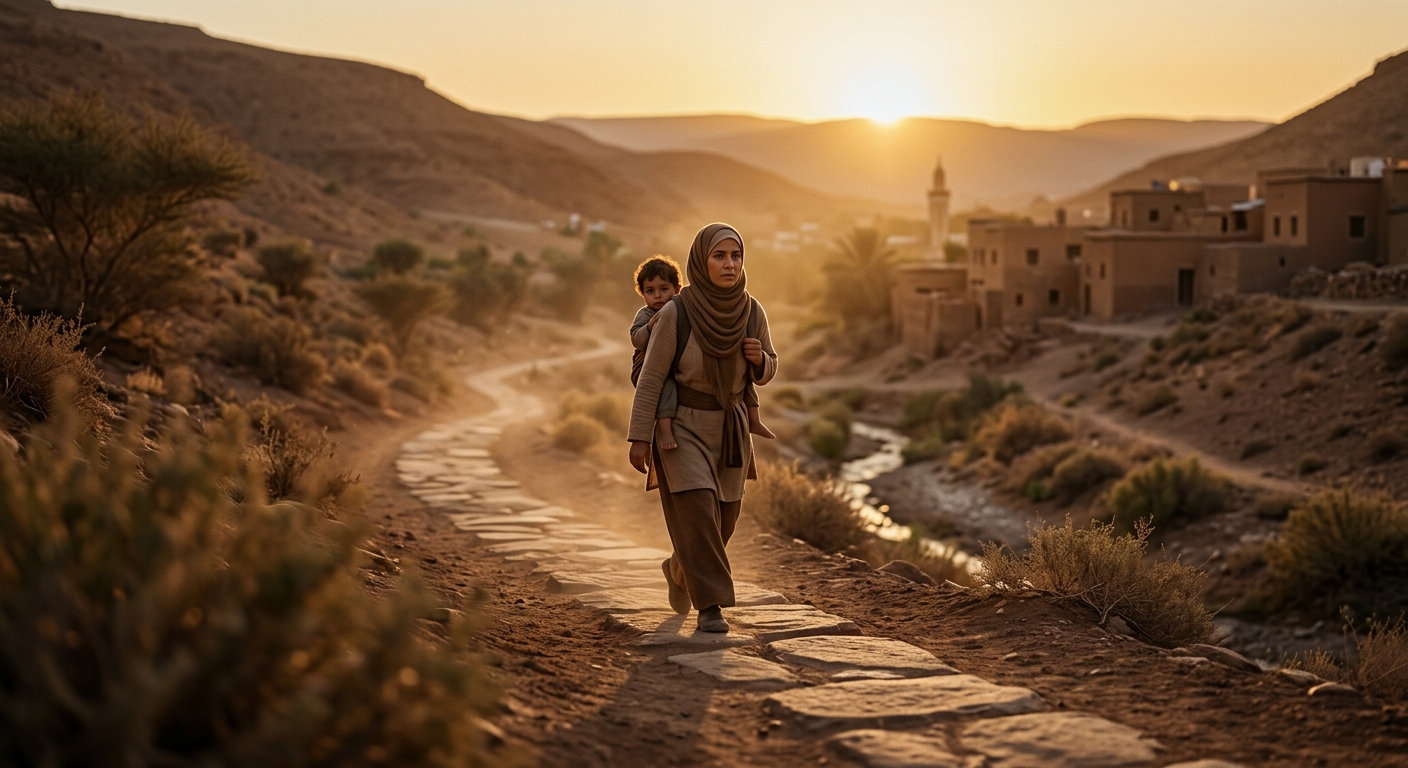
Left in a barren valley with her infant Ismail (A.S.), the “means” of survival (water and food) were zero.
* The Gaze: She asked Ibrahim (A.S.), “Did Allah command you to do this?” When he said yes, her famous reply was: “Then He will not neglect us.”
* The Result: She ran between the hills of Safa and Marwa (using the Asbab of effort), but the water (Zamzam) didn’t come from her running; it gushed from the ground by the command of the Musabbib.
The “Secret” of the Few
The “very few people” mentioned in the text above are those who realize that:
* Asbab are a test of our obedience (we must work).
* The Outcome is a test of our Tawakkul (we must trust).
When “we” stop “chasing” the result and start “trusting” the Source, our restlessness turns into Sakinah (deep internal peace).
Shifting your gaze to the Musabbib-ul-Asbab isn’t just a spiritual victory; it’s a psychological shield. When you internalize that the “means” are merely tools and not the “masters” of your fate, your mental health undergoes a profound transformation.
Sakinah (deep internal peace) turns into Flow State & Excellence (Ihsan)
1. Eliminating “Outcome Anxiety”
Most burnout is caused by the “restlessness” of trying to control variables we cannot. Psychologically, this is known as an External Locus of Control—relying on the economy, your boss, or luck for stability.
* The Shift: By focusing on the Causer, you develop an Internal Locus of Control anchored in faith. You tell yourself: “I am responsible for the effort (the Asbab), but I am not responsible for the result.” This immediately lowers cortisol levels and prevents the “chase” from turning into despair. Mental Health Benefits of Tawakkul
2. Breaking the “Comparison Trap”
The “majority” are restless because they compare their Asbab (their job title, their car) to others.
* The Psychological Cure: Seeing the Musabbib means realizing that Rizq is “tailor-made” for each soul. If someone else has more, it is not because they are “smarter” at using the means, but because the Provider willed a different test for them. This kills envy (Hasad) and replaces it with contentment (Qana’ah). The Psychology of Gratitude in Islam.
3. Resilience Against “Dead Ends”
When people rely solely on Asbab, a “closed door” (like a job loss) feels like the end of the world.
* The Resilience: For the “few” whose gaze is on the Causer, a closed door is just a redirected path. Since Allah created the door, He can create a window. This mindset fosters Grit and Resilience, allowing you to recover from setbacks faster than those who believe their own hands are the only source of their survival. Building Resilience through Faith
4. Flow State and Excellence (Ihsan)
When you aren’t paralyzed by the fear of “what if I fail,” you actually perform better. You enter a state of Ihsan (Excellence). You do the work for the sake of the Creator, which leads to higher focus, while distractions fading away, lower “performance anxiety” & enjoyment, typical of Flow State.
5. Daily Routine of the Heart
To maintain your gaze on the Musabbib-ul-Asbab (The Causer of Causes) while navigating the chaos of the “restless majority,” you can implement this “Daily Routine of the Heart.” It ensures that your Hands are busy with the Asbab (means) while your Heart remains at rest with the Provider.
6. The Morning Anchor (The Intention)
Before checking your phone or emails, set the “Compass of the Heart.”
* Action: Recite the Morning Prayer for Barakah mentioned earlier.
* The Mindset: Say to yourself, “I am going out to seek what God, Almighty has already written for me. My effort is an act of worship, but the result is in His hands.” This removes the weight of “carrying the world” on your shoulders.
7. The Mid-Day Recalibration (The Pause)
When a meeting goes poorly or a “cause” fails, the heart starts to race.
Quran 28:24
* Action: Use the “Musa Moment.” Recite Rabbi inni lima anzalta ilayya min khayrin faqir
* Mindset: Remind yourself that the “boss” or “client” is merely a Sabab (means). They serve as a conduit for your efforts, but they are not the Source. This perspective can alleviate anxiety and maintain professionalism without resorting to desperation.
8. The “Tie the Camel” Audit
To avoid the trap of “passive waiting,” perform a quick check on your efforts.
* Action: Ask, “Have I done my best with the tools God, Almighty gave me today?”
* The Mindset: If the answer is yes, then any outcome—good or bad—is the perfect decree of the Musabbib. This leads to the “Sakinah” (tranquility) mentioned in the Quranic Verses of Peace.
9. The Evening Release (The Detox)
Before sleep, detach your heart from the day’s work.
* Action: Recite Istighfar (seeking forgiveness) and the Du’a of Sufficiency.
* The Mindset: Visualize yourself handing the “results” of the day back to God, Almighty. Sleep with the heart of the “bird” that returns to the nest empty-handed but completely satisfied.
A Final Thought
The “restless majority” believe that more effort always equals more provision.
The “peaceful few” know that more Taqwa (God-consciousness) “is REQUIRED internally as well as in daily practice“; & similarly more Shukur (Gratitude) “REQUIRED internally as well as in daily practice“, are what unlock the True Doors of Rizq(Provisions) & Barakah(Blessings).